Backstory/Introduction
In this website, I’ll talk about the history of musical devices — specifically, electric ones, but, in general, the numerous advancements we have made over the years that have led to the music we all know today, and how this will shape what is to come. Of course, at this point, you may already be considering leaving this page, as this history, nor, if you’re being honest with yourself, any other history, is of much concern to you. However, I urge you to continue reading, as, as I’m sure you’ve heard countless times, music is the universal language, the one thing that we can all share together, regardless of our differences.
Maybe, then, the study of musical devices is not a study of engineering at all, but a study of linguistics. But, then, music is a unique language, unlike any other, for it is one of the few that we can look back, hundreds, maybe thousands of years, and still understand just as well as we can understand that which was created in the present day. Incredible, isn’t it?
That’s what fascinates me about music. There are very few industries that are so resistant to change, yet simultaneously are always changing. Nothing ever grows through stagnation, and music demonstrates that perfectly. Today, we see such incredible diversity of sounds, and unprecedented distribution of music that would never have been heard 50 years ago via the internet. However, we also stand at a turning point: AI is, for some godforsaken reason, seeking to take away musician’s creativity and very realistically kill the entire industry so that the corporations can make more money.
So that’s fun.
We all love music for different reasons. Some of us may not love it at all. But technology has always driven music — that’s what makes it so creative and unique. Whenever we see major advances in science, music mirrors that. We are very good at finding new ways to do weird things that sound good. So I’m writing this paper on those ways.
Sadly, the topic of “devices used to create music” is so incredibly broad that it would be impossible to cover in the amount of time I have, so I must pick a starting point more recent than “the first time somebody hit something to create rhythm” — so, I will start at one of the very first devices used to autonomously produce sound: the humble music box.
Early Sound Devices
Maybe it’s just me, but, if you look at their inner workings, music boxes are pretty ingenious.
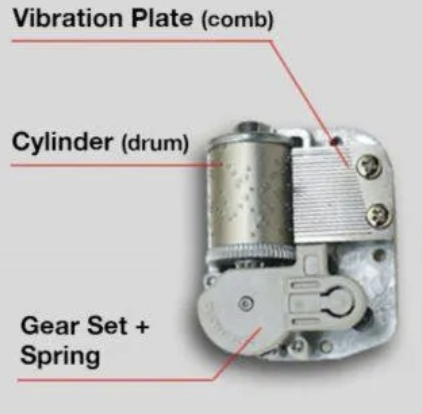
As you can see in the above diagram, music boxes are relatively simple — and modular, as it is the cylinder that produces the song. Each prong on the metal comb is tuned to a certain note, so that when it is plucked, it will play said note. The cylinder has small metal extensions that, as the cylinder rotates when the spring is released, pull on the metal comb in certain places at certain times in order to play a song.
This system, while ingenious, is obviously severely limited, both by the simple fact that you can only put so many notes on the cylinder, and the fact that, in the end, it can only produce one tone of sounds — the “chiming” sound we associate with music boxes. Due to this, the music box is a bit of a dead end engineering wise, and, while some smaller advancements have been made over time, they would quickly fade into the background when more advanced playback devices were released into the market.
In 1857, we saw the creation of the Phonautograph, the very first device that could record a sound — in fact, the oldest known audio recording was created on a Phonautograph! The device could not play back sound, as it was originally intended as a way to study soundwaves. However, in 2008, a group known as the First Sounds Project successfully was able to reform the sound.
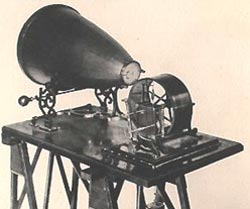
A Phonautograph is pictured above. Sound would go into the cone, at the end of which was diaphragm with a stylus attached. The stylus world moved side to side as the paper spun on the spinning disk, transcribing a waveform.
Of course, these devices could not play back sound without the aid of computers hundreds of years later, so they are often not mentioned in comparison to Edison’s Gramaphone, which would later lead to the invention of the turntable.
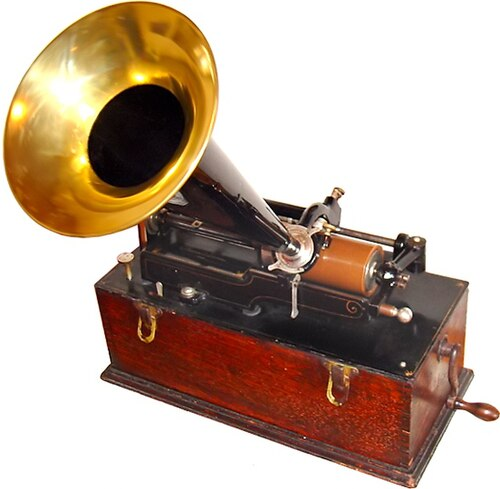
The gramophone was originally intended to work by writing and reading from a grooved cylinder; however, these cylinders were quickly phased out in favor of the flat records we know today. Both methods work extremely similarly: a needle traces down a ridged path, where the ridges match the original waveform of the sound. This causes the needle, which typically had some form of magnet attached, to move in the path of the waveform, inducing a signal which could be played through the horn. As previously mentioned, vinyl records still use this technique, only a much more refined version with a three dimensional groove, allowing for stereo audio.
The Beginning of Electric Instruments
Next, we’ll have to diverge a bit, to talk about electromagnetism. Electromagnetism is the science of magnetic and electric currents and fields, which, as you may imagine, play an extremely important role in virtually everything in today’s world, and, for the purposes of this presentation, electric instruments and amplifiers.
Three main discoveries formed the foundation of this study today:
- Hans C. Orsted’s discovery in 1820 that magnetic fields could be produced by electrical currents.
- Micheal Faraday’s discovery in 1831 that changing an electromagnetic field can induce a current into a circuit.
- James Clerk Maxwell's prediction that any changing electrical field also has an associated magnetic field.
In fact, it was these principles that helped Edison create his gramophone, as it is the magnetic fields created by the moving needle that create the sound from the grooves on disks and cylinders. It also led to the
first audio amplifiers, which used similar inductance technology to push sound through vibrating speakers.
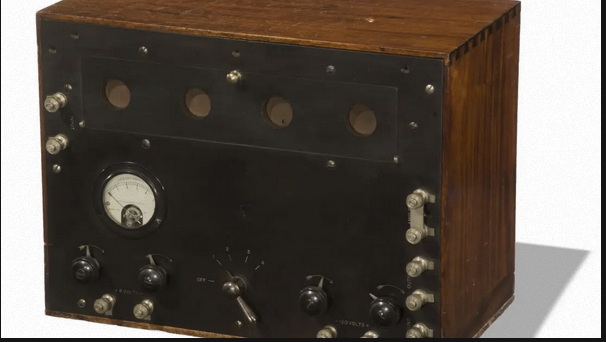
In the earlier 1900s, people had begun to use audio amplifiers for acoustic instruments in order to be louder. However, these were not specifically designed for instruments — rather, they were PA systems intended for things like radio. They required heavy batteries that constantly needed to be recharged, and didn’t even produce very much sound. When Lee de Forest invented the first tube amp, it represented a major breakthrough in amplification technology. Tube amps are louder, can be plugged into wall outlets, and are a lot lighter than the PA systems. The first commercially available electric guitar amp was produced by the Electro String company, later known as Rickenbacker.
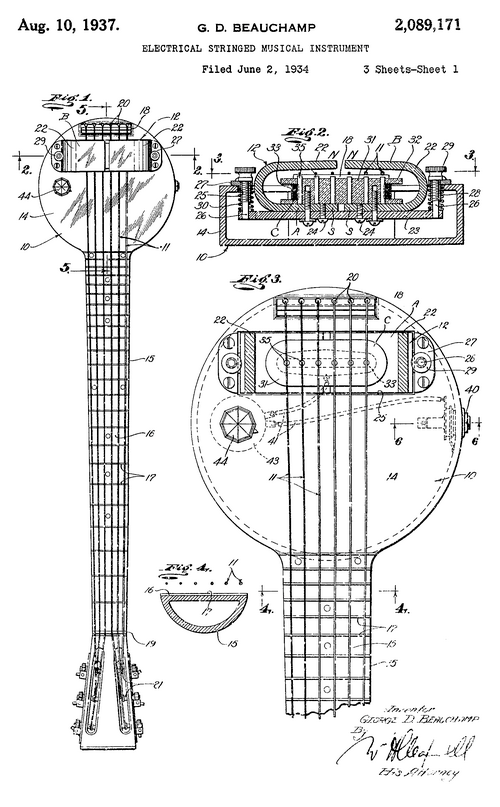
Rickenbacker, in addition to producing the first commercial guitar amp, also produced the first electric guitar, known as the Frying Pan. It used a typical, though not quite as developed as modern technology, pickup system that allowed the metal string vibrations to be picked up by electronics then sent to a power amplifier.
Electric Guitar Design
For a brief moment, let’s talk about how an electric guitar (and almost all other electric instruments) work. As you may know, almost all sound is produced by something called a “pickup”. Pickups are the small, typically black or silver boxes that rest on the body of the guitar. They contain magnetic poles (the small dots often on the surface of the pickup) that produce magnetic fields with the guitar strings, which is why electric instrument strings have ferromagnetic strings — otherwise, they wouldn’t induce current. When the string vibrates, it causes a signal of the equivalent frequency and amplitude of the vibra
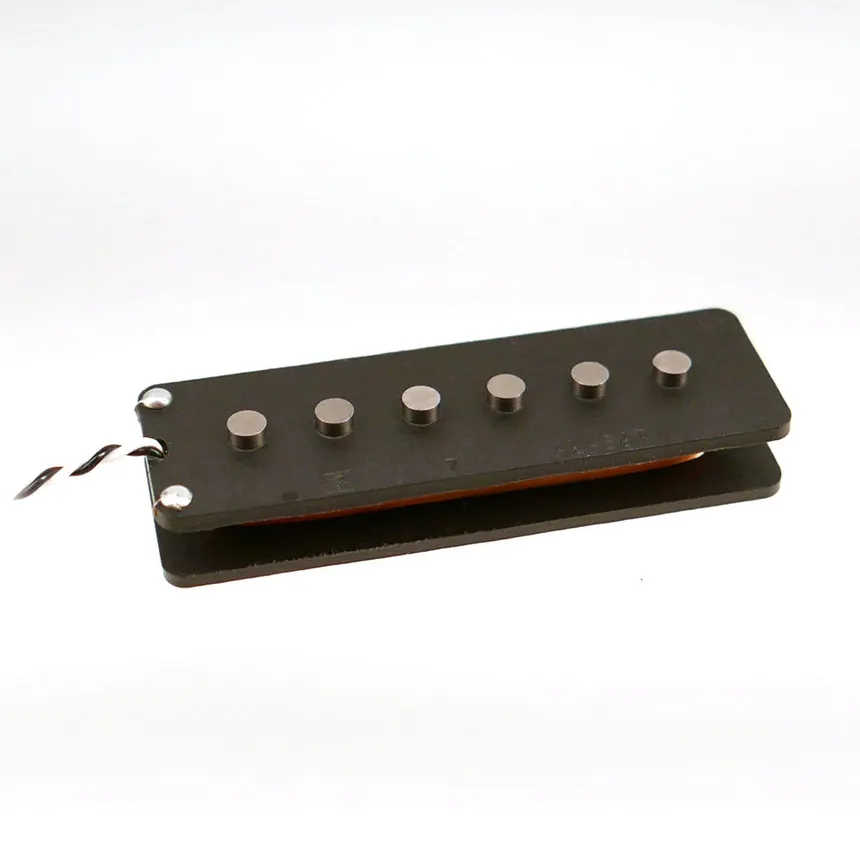
The sound induced from these pickups is then sent onto a wire, through the potentiometers, or pots, which adjust the tone by removing or adding particular frequencies, then into the amplifier. Of course, other pickup designs do exist, such as those made for violins, which work by detecting vibrations in the bridge of the instrument.
Pedals & Effects
For a good amount of time, there were only so many sounds you could get out of an electric instrument — most of them would just sound like an exact amplified version of the original unamplified sound, which is great! That’s what people wanted for a while, so that’s what we had. But people get bored, which often leads to us getting really cool and creative musical ideas.
The most famous and well known effect is distortion. Today, many amplifiers will have a distortion setting/channel built in, because it’s maybe the one effect used in every single genre of music involving electric guitars in some way.
Since the 60s, people have been cranking up their amps as loud as they could in order to get semi distorted tones (especially blues guitarists), but we didn’t see a real device dedicated to distortion until around 1962, with the Gibson Maestro Fuzz Tone.
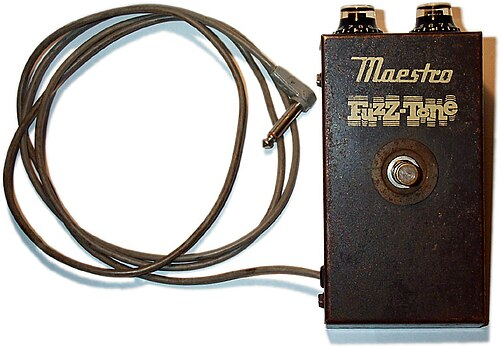
Ugly as it may be, this was the very first guitar pedal to ever be used. Today, most guitars will have boards of anywhere from 3 to 20 pedals to create the sounds they want.
The story behind this pedal is actually pretty interesting — it was made to replicate a tone accidently created by bass player Grady Martin when one of the channels on his amp started having issues, fuzzing out and distorting his tone.
When it was released, the world was not ready for it. People didn’t really want something that made their guitars sound less like a guitar, that is, until the Rolling Stones made it famous with their song Satisfaction. The recorded guitar was actually meant as a stand-in for horns until they could get some recorded, as the pedal had been advertised to make a guitar sound like a trumpet (it did not). The Stone’s manager released the song without the band's knowledge, but, contrary to expectations, the song was a huge success, and caused distortion to go from some weird new technology nobody wanted to the next big thing.
This would pave the way for many more effects pedals to be created, as it expanded people’s minds and made people more receptive to the sounds they could make with their guitars, leading to what are now staple sounds like chorus, flange, and tremolo.
The Future
So, there it is! A short history of electric instruments. Sorry I couldn’t cover more. I hope you enjoyed the history lesson. You probably didn’t. Buuut, I’m sure you’re wondering what the future holds for music. So am I. I reached out to most major music companies asking them some questions about this. They never responded.
My only hope is that something will change with AI. It won’t. But sometimes you gotta hope anyway, right? Music will not look the same in 20 years. It will look worse. The future is bleak. So ignore it! Make music! Do random things that don’t sound good until they do! Try new things, invest in all your dumb ideas, don’t second guess yourself. Nobody ever made something unique and amazing by doing the same thing as everybody else! Sure, do we have a vast swarm of generic artists occupying the billboard? Yes, we do! But that’s not what music is about. It’s not about sales, or money, or popularity, it’s about expression, creativity, and joy! Music is what makes YOU happy. We all have our own kind of music, so we should celebrate that, celebrate our uniqueness, look towards the bleak future and meet it with all of our combined strength!
People will say other things. They’ll say it’s all about the numbers, the money, the yearly earnings. Remember that it isn’t. Money only means an end, not the goal. We live in a world dominated by corporations whose only ambition is to separate you and your money. Don’t let them get to you. Share your music with the world, whatever it may be, and let nothing stand in your way.
Thank you for reading!
(I attempted to contact 5 companies for interviews but none responded)